
Module 4
Chat handles the big moves. Sometimes the change you need isn't that big.
Sometimes it's a vocabulary word that doesn't match your school's curriculum. A sentence you want to rewrite. A question you'd rather swap out. For those, you don't need Chat at all — you can edit directly.
These are the small adjustments you've always made to keep learning feeling consistent and personal for your students. Diffit's manual editing tools make sure you don't have to give that up.
Text formatting — Click into your resource and a formatting toolbar appears. Adjust text, bold vocabulary words, size up your headings, even add emojis as visual cues.
What you can customize in Diffit:
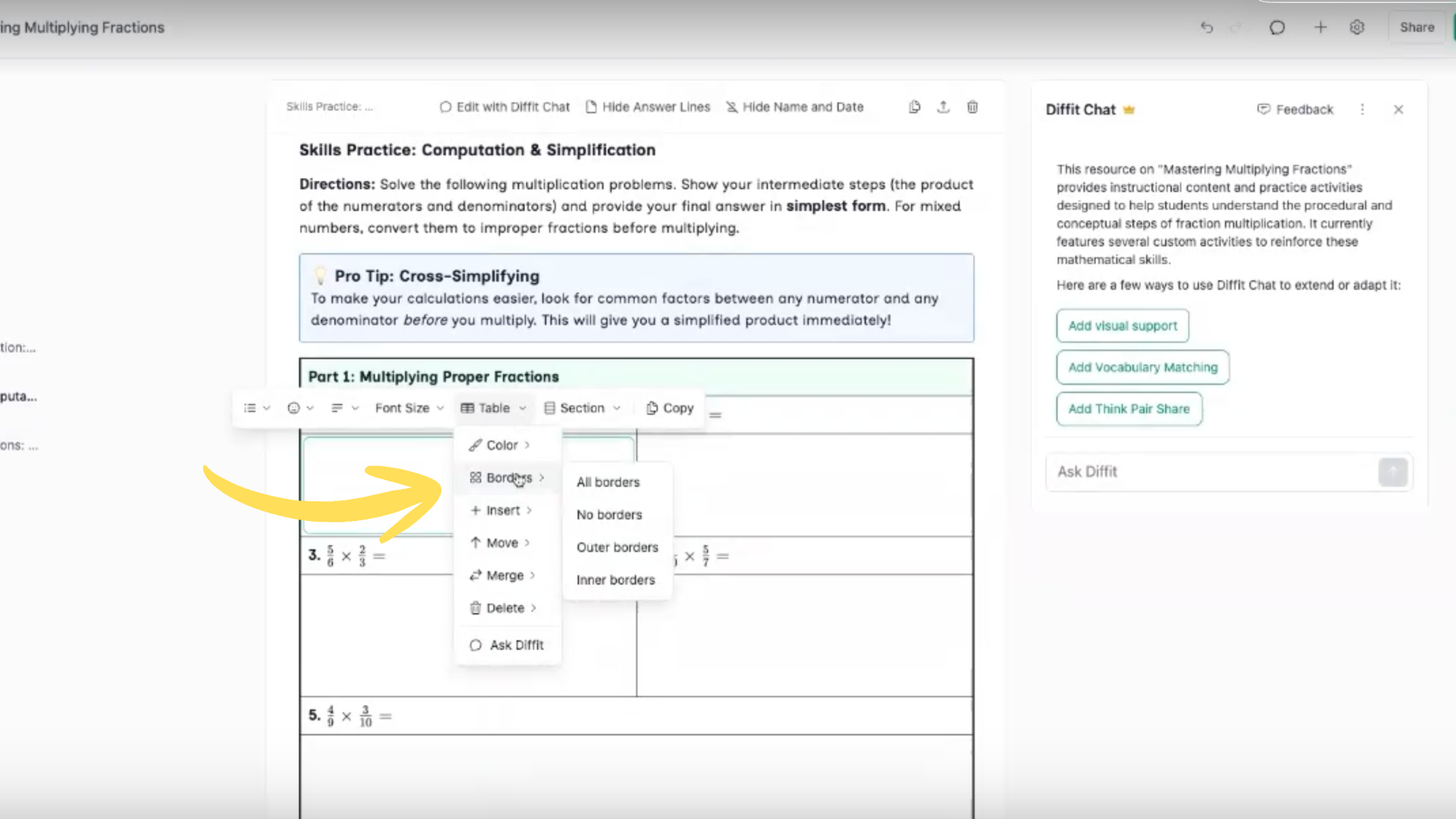
Tables — Swap colors, adjust borders, add or remove rows and columns.
Structure — Add entire sections and activity types, adjust student response space, and more.
-
Diffit Chat handles the big moves, but sometimes the change you need isn't that big. It's a vocab word that doesn't match your school's curriculum, a sentence you want to rewrite, a question you want to swap out for something better. For those, you might not need Chat. You can just edit directly.
Let's walk through the ways you can manually customize your materials. When you click into your resource, you'll see a formatting toolbar appear. You can adjust text, bold vocabulary words, make headings bigger. You can even add emojis to help with visual cues.
And then there are all of the formatting actions. If you're working with a table, you can swap colors, adjust borders, add or remove rows and columns. Outside of the tables, you can add entire sections and activity types, adjust student response space, and more.
If you're ever unsure or you want to add something custom, you've got an easy way back to Diffit Chat. When you click into Chat from the toolbar, it understands that you're making edits to that specific section of the activity.
You're used to making these small adjustments to help your students' learning feel consistent and personal. These manual editing tools ensure that you don't have to give that up.
Here's how to think about when to use what. If you're rewriting a chunk of text, changing the reading level, or adding scaffolds, it makes sense to use Chat. If you're swapping a single word, removing a section, or making a small visual adjustment, that's probably your manual editing.
You don't have to choose. Most teachers use both in the same resource — Chat for the heavy lifting, and manual edits for the polish.
One more thing. If you want two different versions of a resource, like one with sentence stems and one without, that's a great use of Chat too. Just say "add a new version" and include the change you're looking for. It'll show up as a new tab.
Let's pause again. Open the resource you've been working with and try some of these edits. Make one direct edit to the text. Add an activity. Adjust some formatting. Try three small moves, and when you're done, we'll look at sharing and exporting.
Try It
Open the resource you've been building and try three small moves:
Make one direct edit to the text
Add an activity
Adjust some formatting
Then head to Module 5 for sharing and exporting.