
Module 1
You know what Diffit can do. This is about what you can do with it.
Level 1 covered the basics: differentiating instructional materials quickly and effectively for the students in your room. This module digs into the more advanced and creative uses.
There isn't that much more to show you, and that's sort of the point. The features you already know go a lot further than most teachers ask them to. So instead of new buttons, this is a challenge to think bigger about what Diffit can create in your classroom, and where you want to take your students next.
Think about the ways you've watched Diffit help students access content. The ways you've been able to differentiate instruction and assessment. The kinds of learning that opened up as a result. Now: how do you take that to the next level? How do you add more critical thinking, more collaborative learning, more hands-on inquiry?
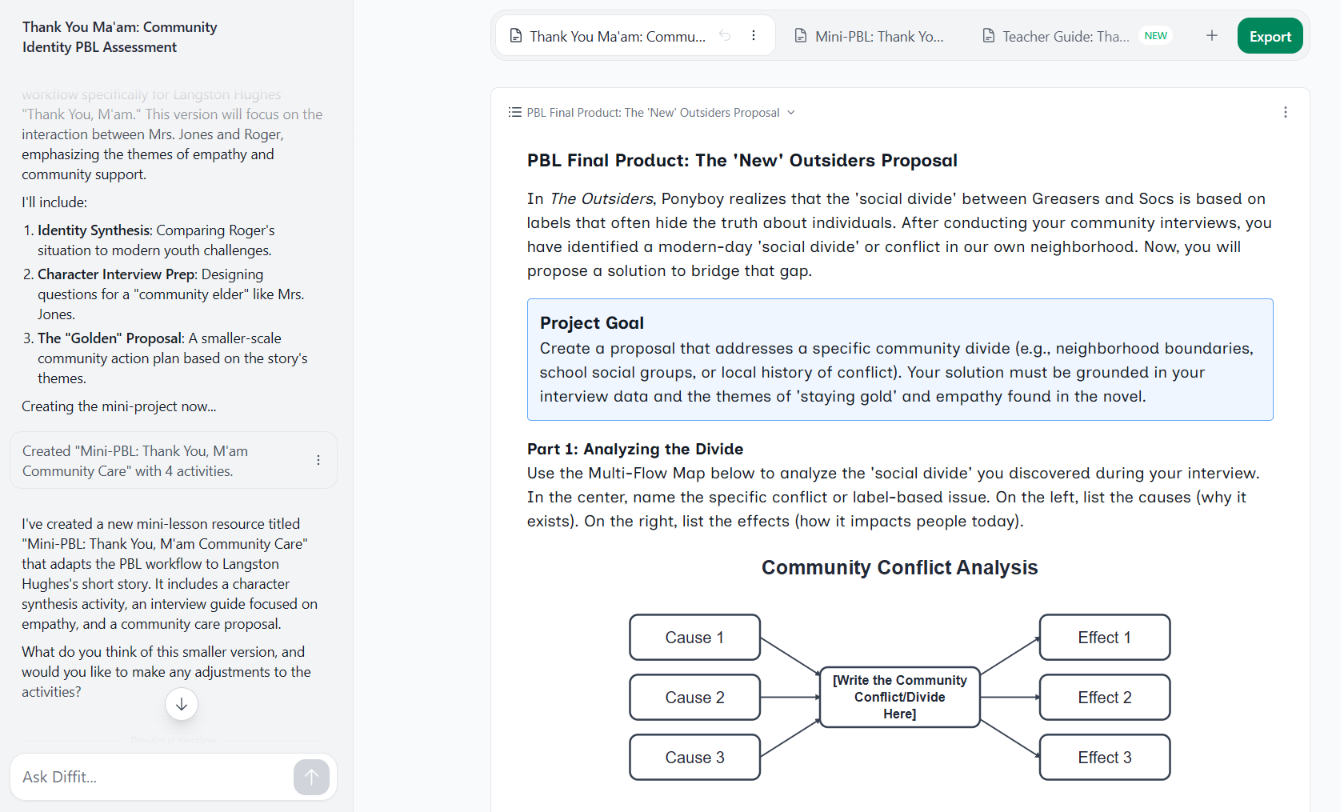
Four moves to push further
1. Ask for a custom activity The phrase "custom activity" tells Diffit you want something unique, and the door opens. Use it during the initial generation or in Diffit Chat, then add detail about the kind of activity you're after. Diffit understands pedagogy, so it will meet you where you are and lift the learning as high as you ask it to.
3. Design backwards Diffit is built to understand where you're going and how to get you there. Upload a rubric, an assessment, or an exemplar product from a previous year, tell Diffit what you want to use it for, and it will help you scaffold all the way back. Try turning a traditional assessment into a project-based experience, or handing over a real-world product and asking Diffit to build the path that gets students to it.
2. Lead with a framework Sometimes the move isn't a custom activity, it's leaning on a structure you already trust. Name the routine or protocol in your prompt. If you have a lesson template or PDF to upload, that gets you further still, though a few key vocabulary terms will often be enough.
4. Just ask On a good day you have all the creative ideas and no time to build them out. On a harder day the ideas aren't there either. Upload an existing lesson and ask Diffit what would challenge your students' thinking. Ask for activities that drive metacognition, synthesis, or real-world connection. It might ask a follow-up question, or it might surprise you.
-
Part 1 of the DCE course was all about the basics of Diffit, and how you can differentiate instructional materials for your students more effectively and more quickly. In this course, we're going to dig into some of the more advanced and creative uses you might have for Diffit.
Now, I don't have that much more to show you, but I want to challenge you to think more about what Diffit can create in your classroom. I want you to think about the ways you've seen Diffit help students access content, the ways you've been able to differentiate instruction and assessment, and the different types of learning that have opened up doors for your students. How do we take that learning to the next level? How do we add more critical thinking, more collaborative learning, more hands-on inquiry?
Let's take a look at some of what Diffit can do, and then I'm going to challenge you to think about what you can do, and what your students can do.
First tip: custom activities. This is a little bit about prompting, either during the initial generation or when you work with Diffit Chat during the edit stage. When you use the words "custom activity," Diffit understands that you want something unique. Use that phrase and the door opens. Then add some detail based on what kind of activity you're looking for. The AI understands pedagogy, so it'll meet you and your students where you are and lift the learning as high as you want.
If you want your students to work together to co-build learning, because we know learning happens best when collaboration and communication are driving, try asking for a "collaborative learning activity," an interactive board game, or a lesson with a built-in discussion protocol or peer-to-peer feedback checkpoints as built-in formative assessment.
If you want your students to get to the learning goal on their own, try "inquiry-led" or "student-led." To extend the learning, you might ask for a research project or a hands-on lab, or just tell Diffit you want to challenge students to make connections between two topics, or between the content and their lives.
If you are teaching to a specific set of standards, learner profile attributes, or a portrait of a graduate framework from your district, you can use that language too.
Sometimes the challenge isn't about a custom activity. It's about leveraging a framework that we know works. Let's say you have a reading that you want students to engage with, and they flew through the comprehension questions and are ready for more. I always love referencing Visible Thinking Routines when I create with Diffit. I might ask for a "Connect Extend Challenge" activity, or a small group discussion based on a Circle of Viewpoints brainstorm with a debate extension activity.
If you have another activity type or learning protocol, try including that in your prompting with Diffit. If you have a PDF or lesson template to upload, that'll get you even further, but chances are Diffit can create something really impressive based on just a few key vocabulary terms.
Next: you've probably heard of backwards design. Diffit is built to understand where you're going and how best to get you there. If you have a rubric, an assessment, or an exemplar product from a previous year, upload it. Tell Diffit what you want to use it for, and it'll help you scaffold and build your students' learning all the way there.
Try taking a traditional assessment and building a project-based learning experience to get students collaborating and thinking critically. Try uploading a product, student-created or something you found in real life, and asking Diffit to help you scaffold a project that guides students to making the product. Again, any vocabulary you include, like "mentor text," "checkpoints," and "self-assessment," will help Diffit tailor the full resource to the content, the learning goals, and the eventual product.
Lastly, at any point, just ask. When I was teaching, on a good day I had all of the creative ideas but not enough energy or time to build out a cohesive lesson. On a less-than-good day I really couldn't even come up with a new idea. Diffit can solve both problems, and it never gets tired of upleveling rigor and learning.
Try uploading an existing lesson and asking Diffit what kinds of activities would help you challenge students' thinking. Try asking for activities that drive metacognition, synthesis, or authentic learning and real-world connections. Diffit might ask you some follow-up questions, or it might generate something that surprises you. There's your creative energy, your lesson design, and your delivery, all ready for you to jump into when you feel ready.
So: you already use Diffit for differentiation. You understand how quickly Diffit can build and adapt learning experiences for you and your students. And you're ready to challenge your students and yourself.
This certification module is all about creating something new that stretches what's possible with Diffit. More importantly, it's about stretching what's possible with teaching and learning. It's about what happens when an expert educator leans on a powerful tool to create and edit materials that will challenge students to think, and to design their own learning.
To get your Level 2 badge, I want to challenge you to design a custom Diffit resource. Design for your classroom, for your teaching style, but stretch it a little. Make it more than a mini-lesson. Maybe it's a project or a multi-day experience. Lead with a research-backed framework. Lead with a learning routine, or ask Diffit to cite one. Build a multi-step project, or bake in some research or collaborative learning steps. Include an authentic or real-world assessment component with a rubric.
When you've created your resource, you're going to publish it as a shareable template. When you publish a resource as a template, you can edit the description to include some additional information. Let us know how the learning experience was designed, including any pedagogical context, instructional frameworks, and learning objectives you included in order to customize the learning and challenge students' thinking. Include any references or information that will help another teacher adapt the project for their classroom.
Finally, head back to the course page and open the submission form. You'll drop in the link to your shareable resource and give me a couple of additional notes, and I'll be in touch with your Level 2 badge.
Thanks for pushing Diffit further, and thanks for pushing the limits of teaching and learning. We learn so much from you every day, and I truly hope this experience is powerful for you. Stay in touch, and thanks for everything you do.
Get Ready
Your challenge is to design a meaningful, multi-phase learning experience for your students. Take some time to think about what that might look like in your classroom. Is there a unit you’ve been wanting to update? A project that fell flat last year? Materials that could use some more inquiry or collaboration? Figure out where you want to go, and then head into the next phase of this certification.